
Rethinking Screen Time: A Parent and Scientist’s Perspective
By Dr. Elise Baron, Director of Research
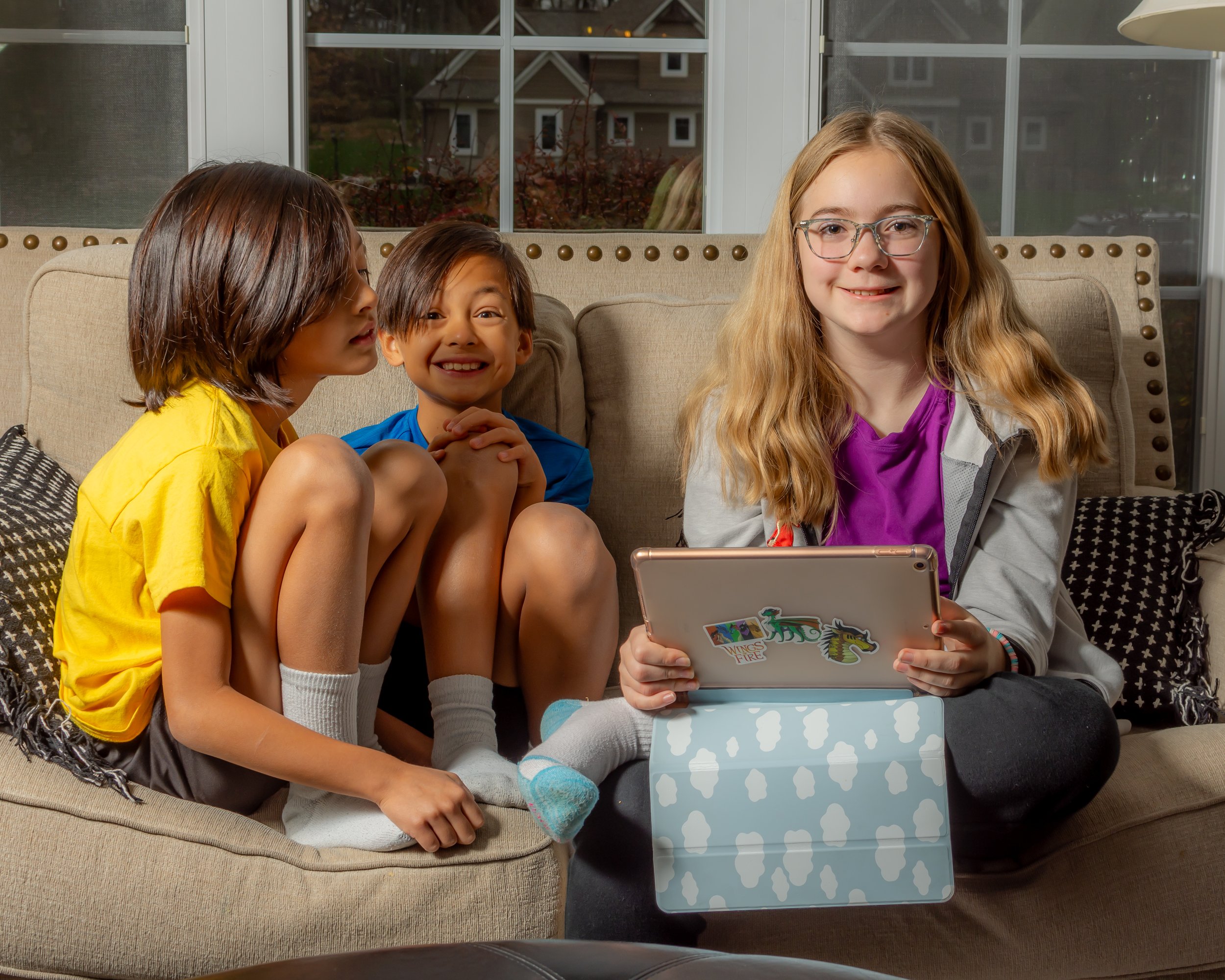
As a parent of two young children, I am acutely aware of screen time and the effects it can have on children. We regularly experience the “time to turn the TV off” whine and protest. Depending on the day, this ranges from tiresome whining to a full-blown meltdown. On the flip side, we have also experienced positive effects! My son has learned about math, science, history, and nature through various types of educational programming. He also likes to watch (and participate along with!) Danny Go! – a show where the characters instruct the viewers to get up and move around mimicking the characters’ movements on the screen. (My kid needs all the coordination practice he can get.) As a scientist who is also a parent, I like to make as many evidence-based parenting decisions as I can. So what does the science say about screen time?
Typing “screen time children” into PubMed yielded 5,195 results. Clearly, scientists have a lot to say. The topics vary widely: how screen time relates to sleep, physical, mental, and social health, language development, nearsightedness, and more. Overall, we know that too much screen time is not good for us, at any age. But everything in moderation, right? So what constitutes moderation in this case? For years, the American Academy of Pediatrics (AAP) recommended a daily screen time limit of 2 hours for children ages 2 and up.1 But as technology and its uses have evolved, so have the recommendations. In 2016, the AAP updated its guidance and moved away from a single time limit that applies to all kids.2 Then in early 2026, it replaced its prior media guidance altogether with a new policy statement arguing that kids and media can’t be viewed through the lens of screen limits alone.3 Currently, the AAP points families and pediatricians to a model known as the 5 C’s: Child, Content, Calm, Crowding out, and Communication. Child – know your child and their personality, and how media affects them personally. Content – the themes being modeled in shows, games, etc. have a significant impact. Calm – ensure that children have strategies to calm their minds and bodies that are not media or screen related. Crowding out – consider what other activities are valuable to your family, and if screen time is limiting time spent on those activities. Communication – aim to establish open dialogue about media, the content, how it makes us feel, etc. to help build digital literacy.3,4 And for those of us who still want a number (I see you, fellow type-A parents), the new policy statement offers a range: less than 1 hour a day for toddlers and preschoolers, and 1 to 2 hours a day of entertainment media for school-aged kids and teens. But it’s clear that high-quality content and making room for sleep, play, physical activity, and reading matter most.3
The nuance illustrated by the 5 C’s can be linked back to the research. Studies have shown that multiple factors are associated with cognitive and behavioral outcomes from screen time, such as content, digital media type, co-use, background television, and caregiver screen use.5 In that meta-analysis of 100 studies, program viewing, background TV, age-inappropriate content, and caregivers using screens during daily routines (think mealtime or bedtime) were linked to poorer outcomes. On the other hand, co-use, meaning watching or playing together with a caregiver, was linked to better cognitive outcomes.5 This basically tells us that not all screen time is the same, and it can vary from child to child. The next question most parents ask at this point is, “Okay, so in which situations is screen time actually good?”
The first and probably most obvious example is educational programming. As a kid who grew up with Bill Nye the Science Guy, I fully support a screen that teaches! Thankfully, the research backs me up here. A meta-analysis of 42 studies found that more hours of screen time were associated with weaker language skills in kids, but exposure to educational programs and co-viewing with a caregiver were associated with stronger language skills.6 The benefits may even last. One study followed 570 teenagers who had been studied as preschoolers and found that those who watched educational programs as preschoolers had higher grades, read more books, and showed greater creativity and less aggression as teens. The authors concluded that the content kids watch matters more than the raw amount.7 One important caveat is age. Infants younger than 18 months have a hard time transferring what they see on a 2D screen to the real world, so they are less likely to learn from it than older kids.8 The Bill Nye magic kicks in a little later.
Then there’s my son’s favorite: screen time that gets you off the couch. Active video games (sometimes called exergames), follow-along movement videos, and similar formats challenge the assumption that screen time has to be sedentary time. A systematic review found that active video games get kids into light to moderate physical activity, and games that use the lower body produce more activity than games played mostly with the arms.9 A meta-analysis of 35 studies concluded that active video games can be a good alternative to sedentary screen time, and a supplement to (not a replacement for!) traditional physical activity and sports.10 More recently, a meta-analysis of 37 randomized controlled trials found that exergaming improved children’s gross and fine motor skills and balance, along with aspects of executive function like cognitive flexibility and inhibitory control.11 Even screen time in the style of Danny Go! has some support. In a recent trial in elementary schools, video-delivered classroom activity breaks increased kids’ moderate-to-vigorous physical activity about as much as teacher-led breaks did.12 The AAP’s newest technical report agrees that active video games can promote light to moderate physical activity, while noting that the evidence on long-term changes in activity is less clear.8
The evolution of screen time from “passive” to “active” excites me most as a movement scientist. For example, in pediatric rehabilitation, interactive screen-based technologies are being studied as a way to supplement traditional therapy. In children with cerebral palsy, a 2026 meta-analysis of 17 randomized controlled trials found that virtual reality and robot-assisted therapies improved gross motor function, balance, spasticity, and activities of daily living compared to conventional therapy. The certainty of that evidence ranged from very low to moderate, so larger, high-quality trials are still needed.13 That’s the idea behind ARWell PRO: harness the engagement of a screen to get kids moving through their therapy.
So where does that leave us as parents? Not all screen time is created equal. The research suggests that the question isn’t just “how long?” but also “what are they watching?”, “are we watching together?”, “what is it crowding out?”, and “is it getting them moving?” In other words, the 5 C’s. So, when my son asks for ARWell, the answer is almost always “Yes!” but we still think twice about scrolling through Netflix. (The meltdowns when the TV goes off, unfortunately, are not something the research can fix.)
References
Council on Communications and Media. Children, adolescents, and the media. Pediatrics. 2013 Nov;132(5):958-61. doi: 10.1542/peds.2013-2656.
American Academy of Pediatrics. Screen time guidelines [Internet]. Itasca (IL): American Academy of Pediatrics, Center of Excellence on Social Media and Youth Mental Health; [cited 2026 Jul 27]. Available from: https://www.aap.org/en/patient-care/media-and-children/center-of-excellence-on-social-media-and-youth-mental-health/qa-portal/qa-portal-library/qa-portal-library-questions/screen-time-guidelines/
Munzer T, Parga-Belinkie J, Milkovich LM, Tomopoulos S, Ajumobi T, Cross C, et al. Digital ecosystems, children, and adolescents: policy statement. Pediatrics. 2026 Feb 1;157(2):e2025075320. doi: 10.1542/peds.2025-075320.
American Academy of Pediatrics. The 5 Cs of media use [Internet]. Itasca (IL): American Academy of Pediatrics, Center of Excellence on Social Media and Youth Mental Health; 2025 May 27 [cited 2026 Sep 22]. Available from: https://www.aap.org/en/patient-care/media-and-children/center-of-excellence-on-social-media-and-youth-mental-health/5cs-of-media-use/
Mallawaarachchi S, Burley J, Mavilidi M, Howard SJ, Straker L, Kervin L, et al. Early childhood screen use contexts and cognitive and psychosocial outcomes: a systematic review and meta-analysis. JAMA Pediatr. 2024 Oct 1;178(10):1017-26. doi: 10.1001/jamapediatrics.2024.2620.
Madigan S, McArthur BA, Anhorn C, Eirich R, Christakis DA. Associations between screen use and child language skills: a systematic review and meta-analysis. JAMA Pediatr. 2020 Jul 1;174(7):665-75. doi: 10.1001/jamapediatrics.2020.0327. Erratum in: JAMA Pediatr. 2022 May 1;176(5):528.
Anderson DR, Huston AC, Schmitt KL, Linebarger DL, Wright JC. Early childhood television viewing and adolescent behavior: the recontact study. Monogr Soc Res Child Dev. 2001;66(1):I-VIII, 1-147.
Munzer T, Milkovich LM, Madigan S, Tomopoulos S, Parga-Belinkie J, Ajumobi T, et al. Digital ecosystems, children, and adolescents: technical report. Pediatrics. 2026 Feb 1;157(2):e2025075321. doi: 10.1542/peds.2025-075321.
Biddiss E, Irwin J. Active video games to promote physical activity in children and youth: a systematic review. Arch Pediatr Adolesc Med. 2010 Jul;164(7):664-72. doi: 10.1001/archpediatrics.2010.104.
Gao Z, Chen S, Pasco D, Pope Z. A meta-analysis of active video games on health outcomes among children and adolescents. Obes Rev. 2015 Sep;16(9):783-94. doi: 10.1111/obr.12287.
Kou R, Zhang Z, Zhu F, Tang Y, Li Z. Effects of exergaming on executive function and motor ability in children: a systematic review and meta-analysis. PLoS One. 2024;19(9):e0309462. doi: 10.1371/journal.pone.0309462.
Szabo-Reed AN, Washburn RA, Lee J, Gorczyca A, Honas JJ, Donnelly JE. Teacher- versus video-delivered classroom activity breaks and student physical activity: the PAAC-3 trial. J Sch Health. 2026 Sep;96(9):e70225. doi: 10.1111/josh.70225.
Zhou H, Zhang Y, Nie M, Ge L. Effects of virtual reality and robot-assisted therapy on rehabilitation outcomes in cerebral palsy: a systematic review and meta-analysis. J Neuroeng Rehabil. 2026 Apr 8;23(1):168. doi: 10.1186/s12984-026-01973-0.