
Motivation: To do, or not to do...
By Dr. Elise Baron, Director of Research
The Merriam-Webster definition of motivation is "the act or process of giving someone a reason for doing something." At first glance, that makes sense; however, it doesn't quite feel right. Although I have been told that the next time I have a craving for ice cream, I should grab an orange instead because it's a healthier choice, it usually doesn't keep me from sneaking down to my freezer. The American Psychological Association gives a more nuanced definition: "the impetus that gives purpose or direction to behavior and operates in humans at a conscious or unconscious level".(1) Aha! I bet my ice cream needs are unconscious!
Two Kinds of Motivation
So, if motivation isn't as simple as "giving someone a reason," what is it? Well, the American Psychological Association also mentions different types of motivation. Two types that really matter to behavior are intrinsic, or internally driven, and extrinsic, or externally driven. Intrinsic motivation occurs when a person feels enjoyment, personal accomplishment, and excitement for the activity itself, making them want to participate.(2) On the other hand, extrinsic motivation occurs when the reward or goal is separate from the activity itself,(3) such as getting a toy as a prize for completing 10 pushups. When it comes to exercise and physical activity, it can be really tricky to tap into that intrinsic motivation. For athletes who love their sport, the motivation is pretty obvious. But what about the average Joe who just needs to do his squats while recovering from a knee injury? What happens when his external motivation, his therapist telling him to do 10 squats a day, just isn't motivating enough? Joe might either a) not do them or b) find a way to incentivize himself into action.
That gap between someone knowing they should do something and actually wanting to do it is a challenge physical therapists face with their patients regularly. Coming up with solutions gets even trickier when the person doing the exercises is a kid.
Why Kids Say "Nope"
Motivation is key to participation, especially with physical therapy, but unfortunately, it’s something that isn’t always there. Up to 50% of individuals prescribed a home exercise program are noncompliant, meaning they do not do their exercises at home exactly how they are supposed to.(4) This leads to patients not getting better as quickly as they should, or not getting better at all. All physical therapists can tell you how important it is to stick with your physical therapy program, whether you are a patient in the hospital, or you are at home recovering from an injury. However, we also know that if you don't feel well, or you are in pain, convincing yourself to get up and do your exercises can be very difficult.
For kids, this is even harder to push through, and there's actual science behind why. Have you ever heard of the famous marshmallow study?(5) In this study, conducted in the 1970s, a group of children were given one marshmallow and told that they could either eat this one marshmallow now, or if they waited for a period of time, they would receive two marshmallows. As any person familiar with children would expect, most participants were unable to stare at a marshmallow on the table and not eat it right away. Turns out, children under the age of 16 have very weak abilities to conceptualize future actions.(6) This means that kids undergoing cancer treatment in the hospital or recovering from a surgery, and who don't feel well, are much more likely to say "nope!" to physical therapy because it hurts right now, rather than to rationalize that even though there is discomfort today, it will help them get better days or weeks from now.
So, we've got kids who are hardwired to prioritize "right now" over "feel better later," combined with exercises that are, frankly, no one's idea of fun when you're not feeling well. This is where Augment Therapy comes in.
How Augment Therapy Taps into Both
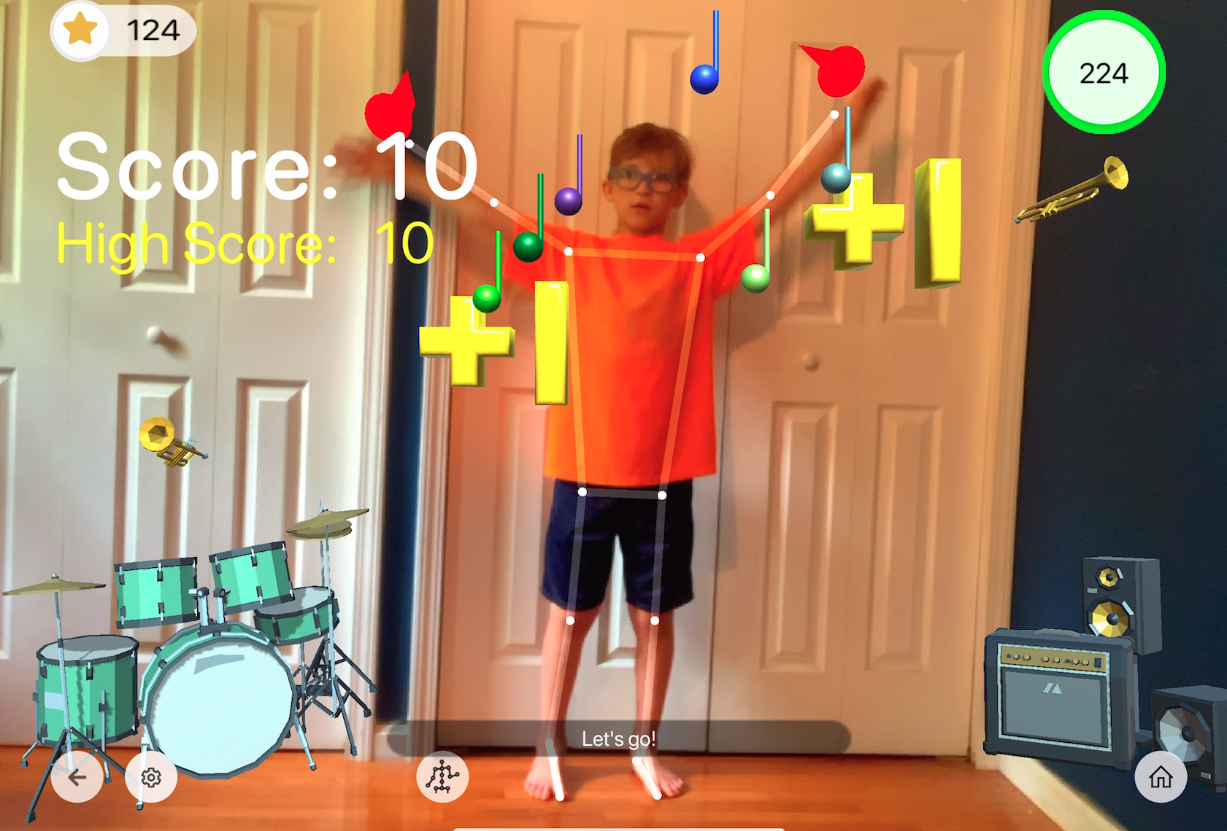
Augment Therapy has embedded different techniques into our software to motivate patients to get out of bed or off the couch and do the exercises prescribed by their physical therapist. The techniques that Augment Therapy uses in ARWell and ARWell PRO tap into both extrinsic and intrinsic motivation.
To support the development of intrinsic motivation for completing these exercises, ARWell and ARWell PRO make them fun! People are more likely to participate in physical activity if the activity itself is fun and enjoyable,(7) so we make every exercise a game. This technique supports intrinsic motivation because the activity itself is enjoyable. To add another layer of motivation, both ARWell and ARWell PRO have a rewards store where the player can spend the stars they earn after completing activities. This technique employs extrinsic motivation, where the player's goal of earning enough stars to purchase a shark costume for their avatar in the rewards store is separate from the participation of the activity itself.
These two examples are straightforward and don't account for individuals' preferences, aversions, interests, etc. In reality, there are lots of nuances to consider when analyzing a person's specific motivations. The different reasons behind a person's motivation are actually more like a spectrum, with some overlap in which motivational drivers are internally or externally rooted.(8) Layering different types of feedback, rewards, and entertainment provides the most opportunities for people, with all their different preferences, to find a reason to play and keep up with their therapy.
The Takeaway
At the end of the day, motivation isn't like a switch you can flip on or off, it's something you build, piece by piece, out of fun, rewards, and whatever else clicks for that particular kid on that particular day. There's no single trick that works for everyone, and that's okay. By layering intrinsic motivation (making it enjoyable) with extrinsic motivation (giving it a payoff), ARWell and ARWell PRO give kids more than one reason to say yes to their exercises, even on the days when "nope" would be a lot easier.
References
1. American Psychological Association. (n.d.). Motivation. In APA dictionary of psychology. Retrieved July 10, 2026, from https://dictionary.apa.org/motivation
2. Deci EL. Intrinsic Motivation. Plenum, New York; 1975.
3. Teixeira PJ, Carraça EV, Markland D, Silva MN, Ryan RM. Exercise, physical activity, and self-determination theory: a systematic review. Int J Behav Nutr Phys Act. 2012 Jun 22;9:78. doi: 10.1186/1479-5868-9-78. PMID: 22726453; PMCID: PMC3441783.
4. Argent R, Daly A, Caulfield B. Patient Involvement With Home-Based Exercise Programs: Can Connected Health Interventions Influence Adherence? JMIR Mhealth Uhealth. 2018 Mar 1;6(3):e47. doi: 10.2196/mhealth.8518. PMID: 29496655; PMCID: PMC5856927.
5. Mischel, W., & Ebbesen, E. B. (1970). Attention in delay of gratification. Journal of Personality and Social Psychology, 16(2), 329–337. https://doi.org/10.1037/h0029815
6. Steinberg L, Graham S, O'Brien L, Woolard J, Cauffman E, Banich M. Age differences in future orientation and delay discounting. Child Dev. 2009 Jan-Feb;80(1):28-44. doi: 10.1111/j.1467-8624.2008.01244.x. Erratum in: Child Dev. 2010 May;81(3):1024. PMID: 19236391.
7. Rhodes RE, Kates A. Can the Affective Response to Exercise Predict Future Motives and Physical Activity Behavior? A Systematic Review of Published Evidence. Ann Behav Med. 2015 Oct;49(5):715-31. doi: 10.1007/s12160-015-9704-5. PMID: 25921307.
8. Ryan RM, Connell JP. Perceived locus of causality and internalization: examining reasons for acting in two domains. J Pers Soc Psychol. 1989 Nov;57(5):749-61. doi: 10.1037//0022-3514.57.5.749. PMID: 2810024.