
Therapist Spotlight: How Augment Therapy Fits Into Denise Campbell's School-Based OT Toolbox
How Does a School-Based OT Use a Virtual Therapy Program With a Gross Motor Focus?
As a school-based occupational therapist, you might look at a virtual therapy program with lots of movement and gross motor activities and wonder, “How would I actually use this in OT?”
Glad you asked!
One of the things I’ve learned using Augment Therapy is that movement activities can address so much more than just gross motor skills. The program includes activities that work on visual memory, visual attention, reaction time, motor planning, crossing midline, bilateral coordination, balance, postural control, body awareness, and more—all skills that can support a student’s participation and success throughout the school day.
Even better, the program has continued to add options to make activities accessible to a wider range of students, including students who use wheelchairs, students with limited movement, and students who are ready for higher-level motor challenges.
Making Group Therapy Easier
One of my favorite ways to use Augment Therapy is during group sessions.
As a school-based OT, I frequently have groups of students who work well together but have very different goals. One student may need direct support with handwriting or fine motor skills, while another benefits from movement, visual-motor activities, coordination practice, or regulating gross motor input.
This is where a virtual program can be incredibly helpful.
A student can log into Augment Therapy, find their individualized program, and pick up right where they left off. While that student works independently on meaningful motor activities, I can provide more focused 1:1 instruction to another student at the table.
Then we can switch!
It allows me to create a simple rotation while still addressing each student’s individual needs.
They Think They’re Playing a Game…
And honestly, that may be one of the best parts.
Students can work on their home exercise program or complete activities that they often perceive as “games.” Meanwhile, they’re practicing skills such as visual memory, crossing midline, coordination, reaction time, balance, motor planning, and sustained attention.
That combination of engagement and purposeful practice can be especially valuable for students who may be less motivated by traditional exercises.
Gross Motor Skills Belong in the OT Toolbox, Too
School-based OT isn’t limited to pencil-and-paper tasks.
Our students need the underlying skills that allow them to successfully access their school environment and participate in everyday routines. Movement, postural control, bilateral coordination, visual-motor integration, motor planning, regulation, and body awareness can all influence a student’s ability to participate in classroom activities.
For some of my students, completing a regulating movement activity before sitting down for fine motor or handwriting work can also help prepare them for the next part of the session.
Another Tool for Meeting Students Where They Are
I don’t see virtual therapy as replacing hands-on occupational therapy. Instead, I see it as another tool in my school-based OT toolbox.
Augment Therapy gives me another way to keep students engaged and actively working toward their goals—especially when I’m managing multiple students with different needs within the same session.
One student can be moving and working independently while another receives direct instruction. Students can return to their individualized programs without starting over each session. And activities can be adjusted for students with a wide variety of motor abilities.
For a busy school-based therapist, that flexibility matters.
And for the students?
They may just think they’re playing a game.
We know they’re building skills.
About the Author:
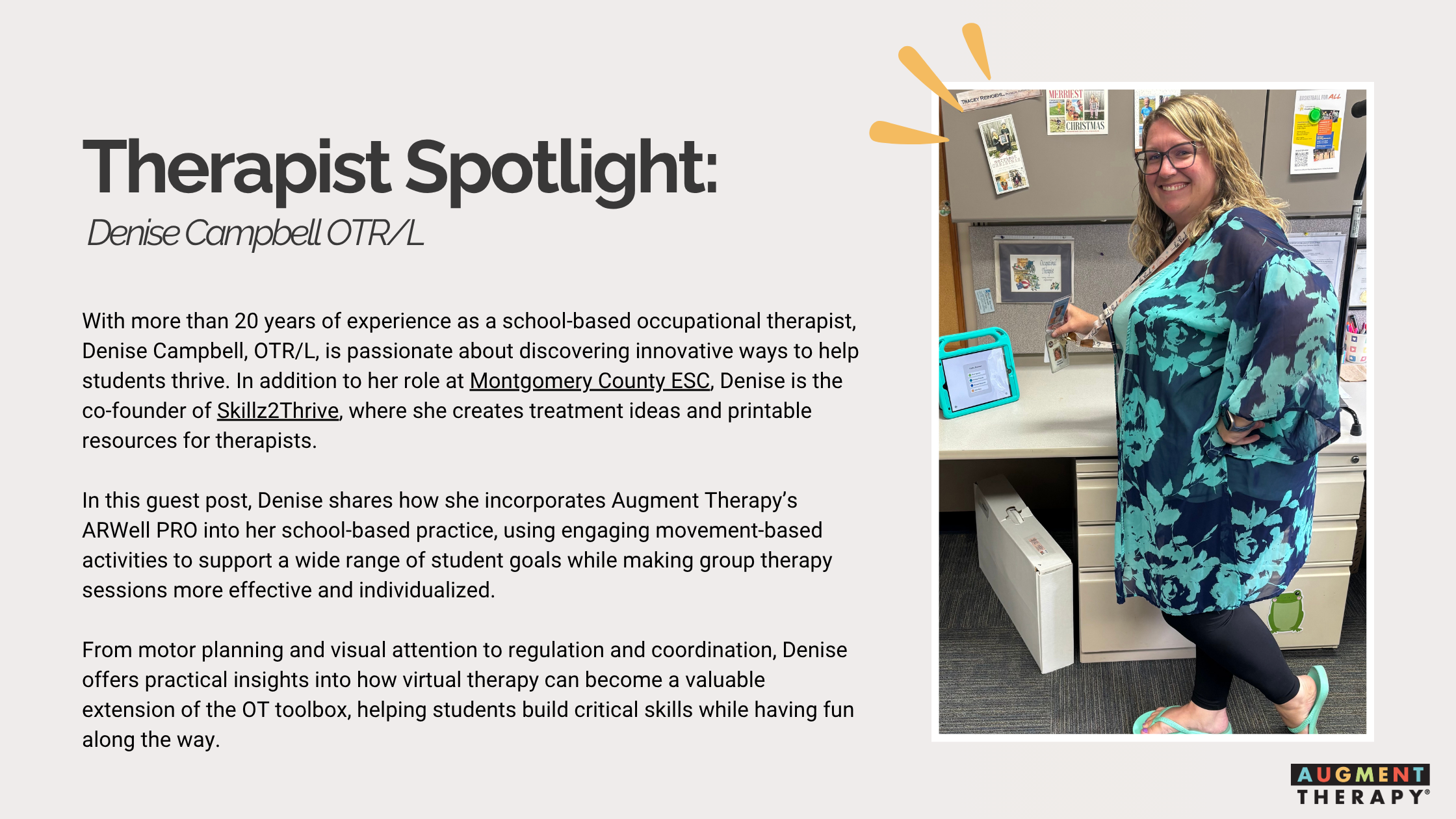
Denise Campbell, OTR/L, is a school-based occupational therapist with over 20 years of experience and co-founder of Skillz2Thrive, a resource platform providing treatment ideas and printable materials for therapists. She is passionate about continuously learning and incorporating new tools and strategies that help students succeed.